Showing posts with label Polls / Approval Ratings. Show all posts

Sunday, November 04, 2012

2012 Election: Electoral Prediction Revised

2012-11-04.03

Okay…  I am revising my predictions for Tuesday.  Slightly.  I will point out that my electoral count has not changed much since my first prediction, but I think I have a better view as to how we will arrive there.2012-11-04.01.

On the right are Nate Silver’s current predictions.  He’s using math.  I am using his math, a couple different poll averages, and then spinning it through my gut.

When I made my first prediction, it looked like Colorado was more likely to go Obama than Virginia.  Today, I thought about flip flopping those two states.  However, they are both close enough that I am actually going to toss both of them over to Romney right now. 

If I was running the Obama campaign, does this mean that I’d concede these states and refocus the spending on other states?  Oh hell no.  In fact, Nate Silver has both Colorado and Virginia going blue on Tuesday night, but I don’t like the odds he has on Colorado and, well, Virginia is Virginia.  They might not have a working telephone when the pollsters call, but they will probably vote, so I want a big margin there before I go blue with Virginia.  Yes, Obama has made gains there since I made my prediction.  Not enough for me to turn it blue, though.

So, Ohio.  Well…  I still am nervous about Ohio.  Flip this red and, with my other updates, we’ve got President Romney. 

Fullscreen capture 1142012 101043 AM.bmpI am, however, cautiously accepting conventional wisdom today and turning it blue.  I think Obama is pulling ahead just enough now for me to lay to rest my immediate fear about, um, intangible and unpredictable factors in Ohio affecting the outcome on Tuesday.

One major factor in all of my predictions?  Romney out performing the polls by 1% to 3%, depending on the state.  This is why I’ve also tossed New Hampshire to Romney.  This is a really close call for me.  My gut does lean towards Obama here, he does have a 2% lead in the poll average (1.5% on RCP) and Nate has it with a 79.4% chance of an Obama win here, but it is just not enough for me.  This is a state where I want to see Obama leading by 3% in all the averages and Nate showing at least an 80%.  I hope to be wrong here, but I am being very conservative in my predictions. 

So, looking at the vote totals, I am still pretty close to my original prediction.  In fact, I almost let my original map stand, since it did have the caveat that it was more about predicting the vote totals rather than how we get there in two nights and I wasn’t sure that a 5 vote change in my prediction was enough to warrant a second post.

But there were enough changes in my state by state predictions, I felt, to justify taking a little time to revise my map. 

It is a tight race.  Not as tight as many in the media would have you think, but a little tighter than many pollsters and pundits are predicting right now, I think.  I still think Obama getting close to or more than 300 voted is pretty unlikely.  However, I think his re-election is pretty likely.

I think this is it.  I no longer see any new factors having time to gain enough traction between this morning and Tuesday morning to significantly change my predictions.  Of course, Romney may be discovered to have a second, third, and fourth wives or being a paid operative of the Chinese government and Obama may reveal himself to be the Anti-Christ, but really? 

I think all of the cards are on the table now and even Sandy, well…  Obama has at least a 10 point lead in the states the most affected by the storm, so while changes in margins there are possible due to the devastation, I do not think they will be enough to change the outcome in those states.

Popular Vote:  Too Close To Predict

As for the popular vote?  I’ll revise that to being a coin toss.  I am changing my prediction of a Romney victory there to a too close to call prediction right now.  Edge to Obama, perhaps, but I won’t put my money on that bet either way right now.

Previous Prediction

2012 Election: Polls & Predictions… A narrow and divided victory for Obama?
Election 2012: Ohio for Romney? Really?

Related Posts

Saturday, October 27, 2012

Election 2012: Ohio for Romney? Really?

2012-10-26.  03.

Yes.  I am sticking to my map. Some disagree with predicting that Ohio will go for Romney. Here is a closer look at that...

Honestly, fear of fraud is one reason I put Ohio in the red.

The second reason is that I am not confident that Obama will sweep the toss up states, and this is a way to show that one of the worst possibilities for Obama would still lead to a narrow victory, more a case playing with the vote numbers than actually predicting which specific states will break red or blue...

But the main reason? I am having a lot of flashbacks to Ohio in 2004 right now.

Here are the pre-election polls for 2004 in Ohio:

D.C. Political Report: Slight Republican
Associated Press: Toss Up
CNN: Kerry
Cook Political Report: Toss Up
Newsweek: Toss Up
New York Times: Toss Up
Rasmussen Reports: Toss Up
Research 2000: Toss Up
Washington Post: Battleground
Washington Times: Battleground
Zogby International: Tied
Washington Dispatch: Kerry

I think Ohio is harder to call than a lot of states due to its demographics and mix of urban and rural areas.

I really hope that it goes to Obama, that would make this election a slam dunk for him. But, I am not ready to bet on it.

I am pretty sure this is why a lot of other people are not ready to call Ohio one way or the other yet, also, even though it is leaning Obama, just as it was leaning Kerry in 2004.

United States presidential election in Ohio, 2004 - Wikipedia, the free encyclopedia:

Pre-election polling showed a lot of volatility throughout the general election. In September, Bush was gaining momentum here reaching over 50% in several polls and even reaching double digit margins in some.

But in October, Kerry gained back momentum as he started winning many of the polls, leading between 48% to as high as 50%. The last 3 polls averaged Kerry leading 49% to 48%.

Related Posts

Friday, October 26, 2012

2012 Election: Polls & Predictions… A narrow and divided victory for Obama?

It’s getting close to the end now and I am starting to get some gut feelings about this one.  Still, overall, I wouldn’t be surprised by either outcome in the presidential race.  However, I would be slightly less surprised if Obama won. 

November 6 is going to be an interesting night.

Game Changers

A little over a week out… Is it too late for any game changers? 

Probably, but a few things do come to mind.  First, Florida looks like it is tightening up again.  If it tilts blue, done.  Early night a week from Tuesday and we all get a good night’s sleep.

Also, as we get a little closer, there is always the possibility that the press starts paying more attention to the fact that it is really going to be tough for Romney to win the Electoral Vote unless the polls are as far off as Dewey / Truman in 1948.  If the media starts talking about Obama’s Electoral Vote Firewall instead of Romney’s questionable momentum (basically manufactured by GOP talking heads, not recent polls), then this could break more in Obama’s direction.

Why?  Because 1% to 2% of these idiotic, undecided swing voters are going to vote for whoever is in the lead because they want to vote for the winner.  Usually this segment is small enough that it does not effect the outcome of the election, but in super tight races?  Who knows?  Usually when super tight races head into election day, they are too close to call and these folks stay home.  But if Obama is looking solid heading into election day, these folks might show up and vote for him, increasing his possible margin of victory.  

Hell, they might even win Obama the popular vote, but more on that later.

Another possibility, especially if the press starts giving more time to Obama’s Electoral Vote advantages…  Romney starts making some last minute, desperate Hail Mary swings through the silly zone.  When this guy goes big, he starts getting strange. 

At this point, though, can any further goofy headlines effect Romney?  Who knows?  But if he is feeling desperate, we may see some interesting moments a la John McCain’s “See, I’m Not To Old To Be President” marathon bus tour on the eve of the election.

Most likely… I predict we might see things firming up a little bit more for Obama in the state by state races, but I think we are pretty much heading into the popular vote within the margin of error, therefore tied.

So yes.  I am going ahead and posting my predictions for November 6. 

I reserve the right to change my mind later if something crazy happens.

Numbers & Predictions: All Hail Nate Silver

2012-10-26. 02.First of all… Let’s jam through the who’s, what’s, and what’s everyone saying…

Five Thirty Eight: Nate Silver's Political Calculus: Oct. 25: The State of the States - NYTimes.com:

Thursday was a busy day for the polls, with some bright spots for each candidate. But it made clear that Barack Obama maintains a narrow lead in the polling averages in states that would get him to 270 electoral votes. Mr. Obama also remains roughly tied in the polls in two other states, Colorado and Virginia, that could serve as second lines of defense for him if he were to lose a state like Ohio.

The day featured the release of 10 national polls, but there was little in the way of a consistent pattern in them.

Nate Silver's Newest Prediction: 73% Obama!:

Although the race is still close in several swing states, statistical guru Nate Silver’s newest prediction is 73.1% Obama to 26.9% Romney

Nate Silver’s track record on election predictions is pretty solid, so much so that the GOP is going after him, apparently.

Republicans Desperate to Spin Romney as the Front-Runner Are Becoming 'Nate Silver Truthers' | Alternet:

…in recent days, the Romney-Ryan campaign has claimed that it's moving ahead. As Jonathan Chait noted, “This is a bluff. Romney is carefully attempting to project an atmosphere of momentum, in the hopes of winning positive media coverage and, thus, creating a self-fulfilling prophecy.” Despite zero evidence that Romney has made any gains since receiving a healthy bounce from the first debate, reporters appear to be buying it, with a raft of lazy stories about Mitt Romney's supposed “momentum.”

A significant problem for conservatives bent on spinning this alternate reality is New York Times ' polling guru Nate Silver and his 538 forecast model, which called 49 out of 50 states accurately in 2008 and is considered the industry's gold standard (the model also pretty much nailed the 2010 mid-terms).

Yeah, don’t even get me started on the “raft of lazy stories about Mitt Romney's supposed ‘momentum.’”  I called that one back before the first debate.

Democracy In Distress: How Mitt Romney will win the first debate:

…what happens next really depends on media spin.  Not the partisan talking heads, but the producers, writers, editors, reporters and directors out there.

The media wants a story to tell.  If the election is pretty much settled a month out, that leaves four weeks of dead air time…  Which they will fill by trying to create the feeling that the race is much closer than it really is.  The problem?  People will start believing it, and everyone loves a come from behind underdog, right?

Sorry, got distracted there for a second.  The press is dead to me and I mourn them from time to time…

Numbers & Predictions: Nate Silver vs. My Gut

So, Nate’s current prediction... 

2012-10-26. 03.

This map brings the Electoral Vote in with Obama winning 303 to 235.  Even if he only calls 49 out of 50, it is a happy night for Team Obama. 

Unless, of course, Nate blows the Ohio call for Obama. 

Oh.  Oops.  Sorry, that was the conventional wisdom I’ve been hearing from press outlets hungry for a story. 

If only one of Nate’s Obama states go for Romney instead, pulling off the 49 out of 50 prediction from 2008, then Obama still wins “easily.”

Colorado, Virginia, and Ohio pretty much ALL have to shift over to Romney for the U.S. to elect its first Mormon president with a final electoral count of  275 Romney to 263 Obama.  (P.S.  I have no problem with a Mormon President and, I fear, that might be the coolest thing about a Romney Administration…)

Of course, there are other paths to 270 for Romney, but this would be the most likely.

There are also a couple paths that lead to the House of Representatives deciding this one.  Even more unlikely than a Romney presidency, but more likely than in most elections.

Nate’s calling this for Obama with a pretty big margin in the Electoral Vote and a bigger margin in the Popular Vote than I am comfortable with right now. 

I think it’s going to be closer.  How much closer?  2000 close? 

I hope not.  But my Electoral College prediction looks frightenly similar to the 2000 numbers.

My Prediction for the Electoral Vote: Obama Wins, 272 to 266

Right now, my personal prediction looks a lot tighter than Nate’s. 

2012-10-26.  03.

This is the tightest it can be with Obama still coming out on top.  Right now, too many things have to break Romney’s way for him to win, in too many states that are leaning blue.  However, unlike Nate Silver, I do not see Obama sweeping all of the “tied” states right now.  This is my worst case scenario for an Obama victory, but I do not think Obama will break 300, though as of now I think he will get 270.

And I am worried enough about shenanigans in Ohio that I am tossing the state to Romney in my prediction.

Obama-Romney Race May Hinge on 2 Ohio Counties | RealClearPolitics:

If the race for president can be boiled down to two key counties in one key state, then those jurisdictions are Hamilton and Cuyahoga, here in the Buckeye State.

And, as Dan Rather put it on election night in 2000, "This race is tight like a too-small bathing suit on a too-long ride home from the beach."

My Prediction for the Popular Vote: Mitt Romney Wins

As for the popular vote, unless some of the game changers I mentioned above occur, I am predicting that Romney will win the popular vote.  Yeah, I know Nate went with Obama.  But I don’t.

2012-10-26. 05.

I don’t like or trust CNN polling this year.  I think they are swinging towards Romney where possible and I believe that they are holding back on making some pretty solid calls on the electoral map just to keep viewers interested and watching, but I do feel like Romney has a slightly insurmountable lead in the COMPLETELY MEANINGLESS national polls. 

However, CNN is not the only one showing Romney holding steady in the national polls. 

2012-10-26. 08.

The polls are pretty much all over the place, but with Obama only leading in three of eleven and tied in one other, I think it is looking pretty bad for Obama in the popular vote.  But, as I said earlier, it doesn’t matter.  Even if we all slept through our civics classes back in junior high, everyone should be real clear on this after the 2000 election - the national popular vote decides nothing.

This Day In History

So, how does this year compare to years past…

2000 was all over the place, a lot like this year. Below is a link to 10 different polls from this date in 2000. 

Bush led in 8 out of 10 polls by margins ranging from 2% to 7%.  Gore led in two polls, by 2% and 3%.

However, the most interesting numbers in these polls come from the swing between Likely Voters and Registered Voters in Newsweek’s poll.

Bush Gains Back Lead in CNN Poll; Gore Maintains Zogby Poll Lead:

Thursday, Oct. 26, 2000

NewsWeek – likely voters (Oct. 18-20)

  • Bush 48%
    Gore 41%

NewsWeek – all registered voters (Oct. 18-20)

  • Gore 45%
    Bush 42%

If this year’s election is still up for grabs, then I predict it will be decided by which side gets their base out and by which side can motivate swing voters leaning in their direction to actually show up and vote. 

This could be a real problem for both sides.  Obama’s base is somewhat dissatisfied with him not living up to the superhuman expectations built up in 2008, and Romney’s party actually thought about going with winners like Newt Gingrich and Rick Santorum before giving into the inevitable and nominating the only candidate that had with a snowball’s chance in hell of beating Obama.

When it comes down to it, I think the advantage here goes to Romney.  I think the far right’s hatred of Obama will overcome their ambivalence about Romney.  And I don’t think the far left has a motivational force of that caliber working on its side this time around, though the “rape is a gift from God” stories couldn’t have hit at a worse time for the GOP.  But it is probably not enough to balance out the Obama hatred.

However, will that be enough to beat Obama?  Probably not.  In 2004, the far left had this hatred for the GOP candidate working on their side.  They also had their own version of Romney in John Kerry.  It was a close election, it came down to Ohio, there might even have been a few shenanigans in Ohio, but not enough to make a difference in the outcome, most likely.  It was Bush’s night with or without the shenanigans.

Electoral Maps 1972-2008:

The 2004 US Presidential Election

The electoral map shown below depicts the results of the 2004 U.S. presidential election in which George W. Bush defeated John Kerry.  Bush carried 31 states and 50.7% of the popular vote.
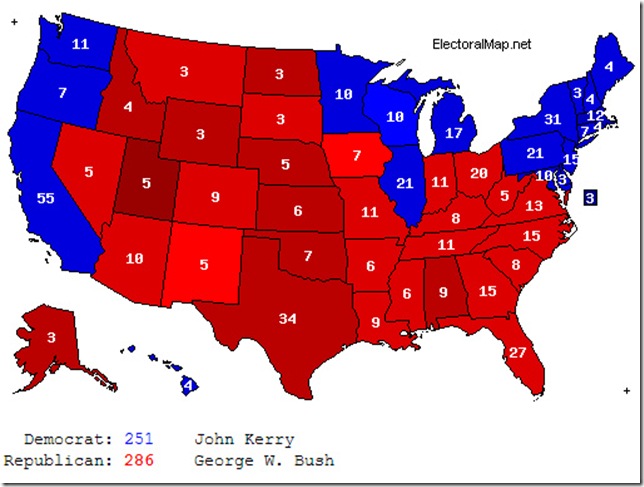
2012-10-26. 09.

Here is a look at the 2004 polls from this point in that election.  Today we probably have about a 1% spread between Romney and Obama. Kerry was down by around 2%. All within the margin of error for everything.

2012-10-26. 06.

One thing is for certain, this is no 2008, when Obama comfortably had the popular vote wrapped up by this point.
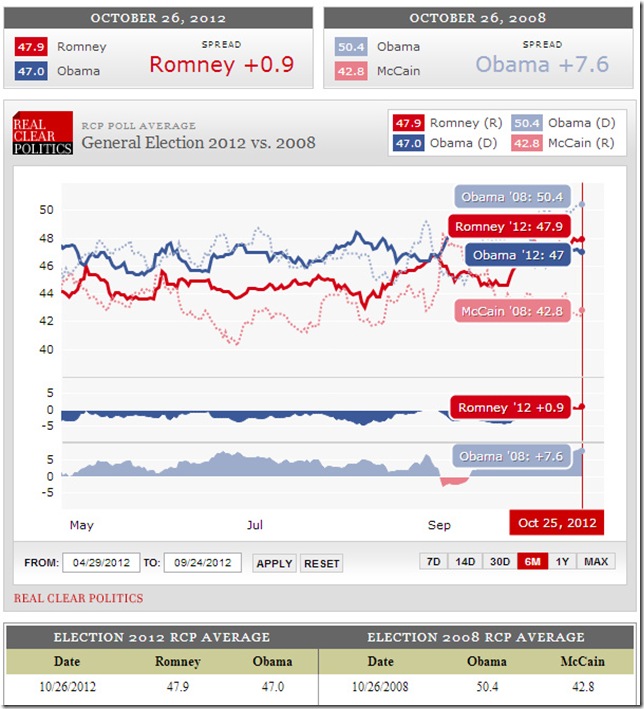
2012-10-26. 07.

Are We Locked In?  Is This A Done Deal?

Well, in the past, including these elections we are looking at here, there have been some changes in the polls heading into the last week.  Usually whomever leads through October wins, which is what the GOP is counting on right now.

However, this is not always the case.  Of course there was Dewey / Truman in 1948.  The GOP candidate was leading Truman by fairly large margins from the spring on.  The final Gallup poll had Truman losing with 44.5%, and he was behind by about 5% at the end of October.  He ended up winning with 49.9% of the popular vote.

In 1952, in the Gallup poll, Stevenson shot up by about 10% in the last couple weeks of the election, with Eisenhower at 51% in the final survey.  It wasn’t enough and the General won with 55.4% of the popular vote.

1960…  Nixon closed around a 4% gap to a 2% gap in the last month or so, and this momentum continued to election day with Kennedy barely squeaking out a 50.1% victory in the popular vote.  In fact, this election was so close, that in a different day and age, it might have gone like 2000.

In 1968 we had a three party election with Wallace absorbing 13.53% of the popular vote and winning five states (46 electoral votes).  Through October into November, Humphrey closed an 8% gap to about 1% going into election day.  But Nixon’s lead held, of course.

Perhaps the modern election that most resembles the 2012 race is the 1976 contest between Ford and Carter. 

1976 Gallup tracking poll: Ford vs. Carter(very interesting reading!!):

Ford made up additional ground following the third debate in late October, again pulling even. In the final pre-election poll, Gallup's numbers indicated a statistical dead heat among likely voters, with Ford at 49% and Carter 48% (the unallocated numbers had Ford at 47% and Carter at 46%). The actual outcome was 50% for Carter and 48% for Ford. The election was so close that it was not certain that Carter would win until the morning after Election Day.

Then of course, we have the 2000 election… At one point in October, Gore was actually down by 13% in the Gallup survey.  By this week in 2000, Gore had closed the gap to 5% according to Gallup, and he continued to surge (if Gallup’s numbers were right, which is unlikely looking at the chaos in the polls that year). 

Of course, Gore ended up winning the popular vote 48.38% to 47.87%.  Of course, 543,895 popular votes count for nothing compared to Bush’s five extra electoral votes (271-266).

So is this over?  Absolutely not, when it comes to the popular vote.  However, Obama is looking pretty solid in the Electoral College unless the polls are off by 1948 margins, which is pretty unlikely considering the refinements in the polling process over the last 64 years.

Could This Be Another Bush / Gore Style Nightmare?

Short answer, yes.  It is possible. 

Could it break like 1960, where Nixon chose not to contest the counts in several close precincts?  Maybe. 

My gut tells me that it all depends on who is up and who is down.  I suspect the man that will say anything to be president would push it as far as it went in 2000, clinging to any chance at all to be president (for all you tea partiers that think I am talking about Obama, sorry).  Obama, I suspect, is smart enough to see how damaging that process can be to the country, and might not take it that far.

Even in 2004, there were enough questions in Ohio that some thought that Kerry should have called for some recounts.  He, however, chose to accept what was probably inevitable and to go out as a classy winner instead of a sore loser.  This was not like 2000 where it was very likely that more voters did vote for the candidate that lost than the candidate that won in the disputed state.  This was less unlikely to be the case in Ohio in 2004.

Unfortunately for Obama, the elections this year most resembles, poll wise, are 1960, 1976, and 2000.  Like 2000, the polls are a bit all over the place.  Like 1976, we have an fairly unpopular incumbent and an untested outsider hovering within a percentage point of each other.  Like 1960, we have a candidate losing the first debate only to slowly crawl his way back in the polls through the later debates and up into the election. 

The final results for the 1960?  “In the national popular vote, Kennedy beat Nixon by just one tenth of one percentage point (0.1%)—the closest popular-vote margin of the 20th century. In the Electoral College, Kennedy's victory was larger, as he took 303 electoral votes to Nixon's 219 (269 were needed to win).” (Wikipedia) 

303 is also the number Nate Silver is calling for Obama as of the evening of the 26th, according to his map, at least.

So, parallels?  1960, Romney as Kennedy, Obama as Nixon because of the debates…. Romney wins.  1976…  Incumbent loses to challenger.  Romney wins.  2000…  Late surging Gore pulls off a popular vote victory and loses the election.  Romney wins. 

But, Obama fans, take faith in the 2004 election….  In many ways, this year’s election bears more resemblance to that one than any of these others when looking at more than just the polls. 

And our, oh sweet Jesus, Bush wins in the end. 

Related Posts

Thursday, October 18, 2012

2012, Debate # 2 analysis & how late night comedy writers will select our next President

While Tuesday’s debate was definitely a win for Obama, it left me with some very ambivalent feelings afterwards…  The following is compiled from my Facebook posts that evening:

Yes, he's not my guy, and I wasn't rooting for him, but from as an unbiased as a perspective as I can manage, I just need to say this...

I think Mitt Romney's debate tonight was the worst performance I've ever seen by a presidential candidate from either party ever. (Well, since the first one I watched in 1984, at least).

Yeah, the post debate “Who Won Tonight?” polls are close, because about 95% of those polled will say their guy won, no
matter what. And don't give me that undecided voter crap on a spot poll taken in the five minutes before the candidates have even left the stage.

But this was a bad night for Romney. It may take a few days for that really to emerge. But it was bad. Bad Bad Bad Bad. Bad.

Bad candidate. Bad. "Was he just trying to help Paul Ryan feel better?" bad.

Going to the mat, standing by his misquote of the President, and then getting fact checked on the spot by the moderator, basically at his own request? YOU HAVE GOT TO BE FUCKING KIDDING ME!

This man wants to be the leader of the free world? Oh hells no.

See, this pisses me off. Yeah, I want Romney and Ryan to lose, but this shit is just bad for America, PERIOD.

I WANT two qualified candidates. I want a tough, close election because there is a real choice, not because of blind party loyalties. I want to be able to take both the GOP and the Democrats seriously.  While I rarely vote Republican, I want the option!


I take Obama seriously. Everyone else can pretty much piss off and die at this point. American politics? Dead.

Yeah, I was typing with fists on Tuesday… 

As for the Town Hall format, the moderators (though a big thumbs up to Crowley, it’s not like she busted in unsolicited), and the debate coverage in general…  In response to this post, “BTW, am I the only person that thinks regular Americans seem to ask better questions than paid reporters?—Dave” on The Pragmatic Progressive Page, I spat out, “Of course they do. Journalism is dead.”

Not a good campaign cycle for America.

Considering Romney’s train wreck of a performance on Tuesday, he is lucky that the takeaway is the “binders full of women” comment.  This will not help him, but there were far worse gaffes in the evening than this one.

So, Obama supporters, yes it is funny, but shut up about it.  People forgive legitimate jumbles of words in high stress situations.  Instead, pound on him for the real mistakes. 

Women in the workplace?  Sure, and we’ll even try to get them home in time to cook dinner.

Getting fact checked by the moderator, at his own request, and losing a point where he actually has some valid concerns and questions about a serious national security failure?

Saying that gun violence would be reduced if only there were more two parent families?

This is what noise should be made about, not the “Binders Full of Women.”  These jokes are funny, but they actually help Romney more than hurting him by distracting from his real gaffes on Tuesday.  Gaffes that might actually work towards changing public perceptions about the GOP contender.

This first clip illustrates a couple points I've been making in several of my posts.

First, people are going to think their candidate won no matter what happened in the debate.

Second, those on the fence are going to be swayed not by what happened during the 90 minute debate, but by the sound bites they hear on a two minute news segment, or by the jokes they hear on late night shows, Facebook, and other sources.

These people are shown supporting their candidate, declaring it a win for their guy, spouting pre-debate buzz about debate expectations, without realizing that the debate has not even happened yet. 

And people like this are going to be the one who decide this election, not the well informed voters who, on a regular basis, actually follow the issues being discussed in the debates. 

This election will be won by whomever attracts the least attention from the comics.  In elections that are not close, the jokes probably serve more as a barometer of public opinion, but in close elections, or even elections at decisive turning points, these jokes can actually shape public perceptions enough that they can change the outcome of an election.

A lot of words have been written over the years about how so many in the younger generations get most of their news from The Daily Show, Colbert, and other such sources, but this is not really a new phenomenon.

More than being the source for news, late night comics have provided the analysis of events that really tend to define how many Americans perceive their candidates.  Dukakis was slayed by these folks, losing his lead in 1988 after a series of gaffes that gave the comedy writers a bushel of full of material.  That election ended up not being as close as the last few, but…

Gore and the lock box in 2000?  Probably worth at least a few hundred votes in Florida.

Kerry / Bush in 2004?  Both were hammered about equally as hard.  Well, in these cases, we see that the tie goes to the incumbent.   

In 2008, one of the most masterful pieces of the Obama campaign was staying out of the late night headlights.  McCain, wandering around the town hall debate, Palin’s, well, everything?  These jokes sealed the deal for Obama.  The piling on as the outcome of the election looked more and more certain through the month of October?

This year, we see this playing out again.  Obama broadens his lead after a series of humorous gaffes by Romney, the race tightens after Obama is hammered in late night after the first debate, and now?  Well, over the next few nights, we’ll see, though I think we know where this will go.

So, the winner of the debates is pretty much decided by headlines and short sound bites on the evening and morning news shows.  The fallout, the shifts of momentum in close races, especially after conventions and debates?  Decided by the late night comics.

A lot of people are saying that the damage done by the first debate to the Obama campaign may have been irreversible.  Not necessarily ensuring a Romney victory, but ensuring a very close and tense election night.  And it might have been the deciding factor if Romney had been able to settle down and keep a low profile for the next two debates and not make any more bad mistakes.  Staying on script, never freewheeling it in public, let alone in front of cameras…

He didn’t do that. 

Earlier, I mentioned The Daily Show, and they have always (deservedly, my bias) gone harder after the GOP than the Dems, but this show does not have the influence of Saturday Night Live, Leno, and Letterman because its viewers tend to be progressive anyway.  Same for Fox News.  Whatever these two outlets are saying about the candidates may influence the

passion of the GOP or Democratic base, but they don’t have much of an influence on the almost completely apolitical swing voters who decide close elections.

I was hoping to post up the Leno and Letterman monologues from last night, but I couldn’t find them anywhere yet.  Apparently, CBS and NBC like to not post them online anywhere until they are stale and irrelevant. I haven’t seen them yet, myself. 

So here’s Conan instead.


Related Posts

Thursday, October 04, 2012

It’s a Trap! Thoughts on the 1st Obama / Romney Debate

Well, it’s going down about how I expected… 

(How Mitt Romney will win tonight’s debate)

After taking a little time last night and this morning to read some reactions and taking some time to process my own thoughts, I am ready to throw my two cents into the ring.

First of all, I hate it when a team loses a close game and then all the fans blame the officiating.  Bad form.  If the game wasn’t close, the refs’ calls would not influence the outcome.  Bottom line, whomever won or lost the debate, leave poor Jim Lehrer alone!

Second of all, did Obama really lose?  Or, more importantly, could Obama have won this at all? 

As I wrote yesterday, there is no way that Romney was going to look bad last night.  After everything that went down in September, even those of us who knew better were half expecting a drooling moron to stumble out onto stage with his shoelaces tied together.

With the expectations so low, there was no way that Romney wasn’t going to come off surprisingly well.  Let’s not forget, one of the biggest selling points for him early on in the primaries was that he looked and spoke the most like a president out of anyone else in the GOP clown show field of contenders this year.

Yes, Romney looks and talks like a president.  Casting a movie?  He is your guy.  Hiring a real president?  Well, that is a different story. 

My point is, Romney was made for last night.  Obama does well, and I think he did well last night, more on the President later, but Romney’s a candidate perfectly built for this debate format.  Stand up there, look and sound “presidential,” and don’t worry a bit about the hollow content of the words. 

The way these debates are “judged,” and I use the term loosely, the candidate whose performance most resembles a cardboard cutout movie president is usually declared the winner in debates with last night’s format.

Couple this with the low expectations on Romney and Obama didn’t stand a chance last night.

Going in, I think his campaign knew it.  And these guys and gals are true pros from Dover.  2008 and this year are two of the most seamless campaigns I’ve ever seen.  No real mis-steps at all.  Almost perfectly planned and executed.  So, was this the first big “gaffe” of the campaign?

I think not.

I know a lot of Obama supporters were hungry for a decisive, knock out blow last night and mistakenly thought that Romney was primed to receive just such a blow, but he was not.  As I said, there was no way Romney was going to lose this debate. 

The only real question was how badly the President was going to get beaten last night, and how badly the loss was going to damage his re-election odds. 

If Obama went in swinging, he would have looked desperate and cheap to many Americans, would have provided fodder for the Romney campaign through the entire month of October, and potentially would have walked away from last night with his campaign in real trouble.

Yes, the left was hungry for red meat, but the rest of the country wanted to see what Romney had to say.  If Obama went after Romney hard last night, I think instead of the President being criticized for seeming a little off his game, a little tired, a little out of practice and, maybe, even a little nervous, I think the criticisms would have been much more harsh if he seemed angry, combative, or, God forbid, mean.

Such a performance would have been called “unpresidential.”  And that is the worst label you can take away from one of these debates.

So, I believe, Obama intentionally stood back a little and let Romney have his night.  The goal was damage control, in a sense.  Let Romney have a little win, not a big win, and then hang him with his own words over the next couple weeks.

In fact, this is probably the second part of Team Obama’s strategy last night. 

Let Romney feel good about how things were going, gently chide the worst of the attacks and spins, but just let him roll on, providing more and more amorphous “details” while contradicting his own stated policies over and over with more and more confidence, and then completely devastate him with swing state ads over the next few weeks before the election.

When looking at last night’s debate from this perspective, it would seem like Obama did achieve these goals. 

Romney “won” his inevitable victory without really damaging Obama and the President didn’t give the Romney campaign much, if anything, to use against him later.  And Romney flip flopped on issues to such a degree that there may not be enough time left in the campaign to call him on every point and detail, but more than enough time to effectively hang him with his own words.

It was a trap, I tell you…  Now we’ll see if it worked.

A final thought on Obama’s performance.  Perhaps some of his nervousness and apparent discomfort early on actually came from his feelings about last night’s strategy.  Maybe Obama, too, wanted to go after Romney and wasn’t entirely comfortable with the strategy of laying low and letting Romney have his night.  However, he showed a lot of poise, overall, in trusting his team and sticking to the game plan.

Of course, the Democrats’ ace in the hole is the format of the second debate.  If Romney is the perfect candidate for last night’s format, then the town hall format of the next debate is Obama’s.  The embarrassing Romney performance that many Democrats were hoping for last night may still be on the schedule…  Just not in the time slot they expected.  Romney has a bit of explaining to do to 47% of America, and it will be interesting to see how he handles their questions in the next debate.

I think we can all agree, dealing with the “public” is not one of Prince Romney’s strong points.

Then, if needed, Obama can always go after Romney hard in the third debate when the playing field is leveled and the expectations on Romney are higher, when he needs to do more than just show up with his pants on to win.

Let’s face it. The image of Romney as an incompetent moron was an unexpected gift keeping his campaign down and out through September, but it was unexpected and unsustainable. Let’s move past it now, early, and get back to the strategies that are really going to matter, really going to decide this election in the long run.

As for the embarrassing media commentary last night, I’ll leave it with this…

Right Off A Cliff: Status Update:

President Obama sucked it up tonight....

But we feel it was done on purpose. The key issues against Romney such as the 47% comment, offshore bank accounts, the ER health care comment, his tax returns...none of this was mentioned. Which even on a bad night you'd mention at least 1...if not more.

It seems Obama came out knowing Romney would go full out and decided you know, people have short memories it's better to hammer him on these issues the last 2 debates than explode with them in the first debate and have them forgotten weeks later.

Romney, to his credit, was well prepared. Though anyone who knows what's been going on knows that more than half of what he said tonight is a complete contradiction to what he's stood for the last 18 months. Hearing him say he likes regulation is something you have NEVER heard him say...ever. It's a complete 180 on what he's run on since the beginning.

The moderator was flat awful as well. The topics were disorganized and format was terrible.

Make no mistake though...Obama must come out stronger the next debate or Romney is going to close the gap in a hurry.

Mitt Romney Gives Obama All The Lies He Needs to Hang Him With:

As Ed Schultz loses his mind on MSNBC and claims that Obama didn’t try to “win” the debate, the reality is that Romney gave the Obama people a treasure trove of lies to attack the Republican nominee with from now until the next debate. For Barack Obama this debate wasn’t about getting into some sort of ugly street fight. Voters like Obama exactly because he doesn’t do that. For Obama this debate was about who do you trust more?

Mitt Romney stood up and lied to the American people repeatedly. Obama is the trusted candidate with the vision. Romney is the challenger who had to be in chase mode because he is losing.

This debate wasn’t a game changer for Romney, despite what Republicans may think. His biggest problem is he is still Mitt Romney. While the media may give it to Romney, voters are still likely to stick with Obama."

Debates don’t move polls. Debate winners do. | The Signal - Yahoo! News:

…debates have a reach beyond the immediate bump or slide in the polls as they seep into the narrative and offer up ammunition for campaign commercials. With nearly two full weeks until the next presidential debate, the results of this one have a long time to hang around. Romney's solid performance can lead to new donations that, in turn, lead to better poll numbers in the following weeks.

In this way, debates are the opposite of conventions, in which we advise you to ignore the bump in the polls since it inevitably fades. After debates, we advise you to ignore the nonbump in the polls, because it may grow.

A note on the above clip:  In this case, I think the Democrats come away with much more in the way of “ammunition for campaign commercials.”  I suspect that this “victory” for Romney may turn out to be a fairly bittersweet one.

Colorado presidential debate: Media piles on moderator Jim Lehrer - Mackenzie Weinger - POLITICO.com:

The consensus: Lehrer did not control the debate, failed to enforce the time limits, did not press the candidates enough and generally was steamrolled by the presidential candidates, Mitt Romney in particular.

Related Posts

Monday, January 30, 2012

What do I believe in? The political world according to A. F. Litt


Prelude

On my personal website I have been building a library of my academic papers from my school days.  Tonight, I found one that I thought I would share here.

It was a quick response paper for a cultural anthropology class at Seattle Central Community College some sixteen years ago.  Not my best writing ever, for a class or otherwise, but, clunky writing aside, in many ways I think this little piece sums up my political views better than anything I’ve written before or since.

It does not detail where I am on the left or right spectrum, conservative or liberal.  On that scale, I am far from static and can usually manage to upset people on both sides of that particular divide.  It does, however, explain my opinion on how the American political system operates.

After the massive political failures in Washington D.C. over the last decade, I suspect that more and more people have come around to seeing things from my perspective.  Back in 1996, though, my ideas on government and the media were dismissed as naive by many from both the right and the left.

The popular view was that great, unseen political machinations were pulling the strings of power.  Everything was a borderline conspiracy, or an actual conspiracy. 

After watching both parties shattering like glass against the rocks of their own incompetency the last few years, however, I feel that my views on the system are a bit more mainstream now.  Reading this essay for the first time in about 12 years today, it actually felt fresher than it did in the days of the Clinton Impeachment Trial and the WTO controversies, before the 2000 Election, eight years of George W. Bush, endless wars in the Mid-East, Hurricane Katrina, the Great Recession, and whatever sort of tragicomic train wreck the last six plus years of Congress will be labeled as by future historians.

Enough from me today, onwards to me from years past…  This is warts and all, copied and pasted from the original Word document.

ANT 202, Fall 1996, Seattle Central Community College

Until recently, I had never read anything by Noam Chomsky, or heard him speak before, but I have run into many people who have and are rather worked up by his ideas. Many of these people, however, tended to have a very paranoid streak in them, and have used Chomksy’s words to confirm their own fears and suspicions about conspiracies and such. They use his ideas as proof that their fears about direct manipulations between corporations, government officials and agencies, the media, and the financial institutions are true. Instead of understanding the subtle and indirect influences these institutions, by nature, have upon one another; they just take these concepts in their bluntest, broadest forms, picturing some sort of wild X-Files type of conspiracy. They believe, in a very literal way, that all politics are nothing but a sham, that the corporations directly control everything, making phone calls and e-mails, ruling directly a puppet government, themselves taking their orders from the global financial institutions. I always ask them where the aliens fit into these schemes, and not all of them realize that I am joking. Because of these people, I have always been a bit weary of Chomsky, but knowing these people’s mind sets, I figured they were just laying their own fears over his ideas, and I’ve always wanted to find out if I was right.

My own view of government and its relationship with the private power structures has always been more of a chaos theory, rather than a conspiracy theory, seeing each individual and group being too caught up in their own special interests, and too busy covering their own asses, to ever work together at a level that such a complex conspiracy would require. There are just too many egos involved. My own view, it turns out, seems very similar to Chomsky’s. So, when listening to the conspiracy theorists talking about the power structures, about the relationships between industry, government, and the media, I’ve never been able to totally disagree. I’ve always ended up with sort of a “Yes, but…” and a “Well, I wouldn’t necessarily go that far” response. I can’t follow them all the way into the conspiracies. For these to actually be occurring, the politicians, CEOs, and journalists would all have to be a lot less self serving, and a hell of a lot smarter, than they ever seemed to be, to me, at least. In 1991, while attending a National Press Club conference in D.C., for example, I had an opportunity to meet briefly with former Rep. Rod Chandler and former Sen. Brock Adams. To be honest, these two were so preoccupied with themselves and with their own personal career goals (Adams, understandable, more so at this point – still vowing to run again, still certain that he could win), that I don’t see them plotting anything with anyone, unless they got to be in charge. When talking about legislation, bills they sponsored, bills where they offered up key support, they never talked with enthusiasm about the laws they were making, or about how they were good for their constituencies, but they were very jazzed up about how powerful they were personally, being able to make that big of a splash on the national issues. Chandler, being groggy from getting back from a fact finding mission to Kuwait, came across as a complete fool and managing to drop in a couple of racist comments, thinking that he’d made a funny, certainly didn’t help his case any. If this guy was ever involved in anything serious, I’d be willing to bet that he’d accidentally expose it. Of course, my paranoid friends all reassure me that these cases were all just acts, that they were ploys to lower our expectations of elected officials, and to lower our defenses.

Still, I feel that these politicians do try to do their best to stand up for and to fight for what they feel needs to be done, but it is no mystery to me how things like aid to the Guatemalan military gets passed by these people, as well. They see the word communist in the early 1980s, and communists are bad. If they don’t vote against the communists, they will endanger their re-election. In these circumstances, why should they even worry if the guerillas are even really communist insurgents or not, why should they waste any effort trying to dig deeper into this issue? It would just be a bother because they already know how they must vote, and so they probably never realize that they were aiding in the suppression of the Guatemalan public, and not in the suppression of the “Evil Empire’s” backing of Soviet-style communism in the Americas.

Likewise, the media. Journalists, like politicians, feel that they and not their possible replacements are the best for their jobs, that they will fight the good fight in a way that they are uniquely qualified for, in a way that their potential successors are not. On top of this, or in place of this, let’s face it: unemployment sucks. In the media, votes count as much towards job security as they do in politics. Here, however, the votes are cast through ratings and circulation figures instead of elections. Using the Guatemalan example again, in the early 80’s the American public was largely uninterested in Central American political struggles, just writing it all off as those damn Cubans working with the Soviets to expand communism closer to the States, and being bored with anything deeper than that. A minute or two here, a few column inches there. The sort of publicity needed to truly educate the public about these freedom fighters, the time and attention needed to explain that these repressed Indians were not really communists, and definitely not backed by any communist nations, would have sent, let’s say, the evening news ratings into the trash. Maybe some journalists knew about the situation down there, and they felt strongly about the need to bring the details to the public’s attention, but often they will sacrifice that story for another one they also feel strongly about, one that the public is more interested in, one with a higher ratings potential. The instinct for self-survival wins again.

This is how I see these two institutions working. It’s not that they are working together, it’s that the very nature of our society forces them both to work in ways that, in this case, serve each other well. Real issues become fuzzy sound bites that end up largely dictating American policies. And it is definitely not Sen. Doe calling up Jack Blowdry, having the network nix the story so Congress can get away with something. Most journalists I’ve met would run screaming to the showers seeking purification at just hearing such a suggestion.

So, getting back to the Chomsky interview, it was very refreshing to hear him say pretty much these same things, confirming my suspicions that he wasn’t a conspiracy theorist, and in fact, hearing him bluntly deny it. My paranoid friends, it seems, weren’t only misunderstanding his message, but completely missing the most important part of it all, that we do live in a free society, and that these institutions don’t have the strength that they would have if such a conspiracy was taking place. (Totalitarianism, anyone?) It’s the capitalistic democracy we live in that creates the appearances of a conspiracy, but it’s also this system that gives the public’s opinions so much strength. It’s the public’s voice, expressed through votes, and sales, and ratings, and such that fuels this system. It’s the fear of a negative opinion that brings out the negative aspects of this system. The idea, as Chomsky put it, that while in a totalitarian system, backed by violence and fear tactics, it doesn’t matter what the public thinks, only what it does, and that the powerful don’t need the support of the public when they decide policy, but in a capitalistic democracy the thoughts of the public are very powerful and potentially dangerous to those in charge while being the hardest part of the system to control, and the support, or ignorance, of the public mandates the policies of the powerful. Therefore, the fear of a negative opinion, of being perceived as another Mondale instead of another Reagan, of selling Pintos instead of Cadillacs, creates a situation where the truth is something to be feared in case it is taken wrong by the consumers. Image become more important than reality, and the truth, or at least the details of the truth, are avoided when possible by anyone selling themselves to the public.  The truth is only investigated and reported by the media if it is exciting, importance or relevance becoming only a secondary consideration.

For example, when the Watergate scandal was being uncovered by the Washington Post, the idea of corruption on that level in the executive branch was big news, but after Nixon and 12 years of Regan/Bush, it’s going to take Clinton being caught at something a lot more clear-cut and scandalous than Whitewater to capture the public’s attention in the way it was by his predecessor’s misdeeds, 23 years ago. [I will interject here in order to point out that this essay was written before Monica Lewinski and the Impeachment] These days, however, O. J. Simpson managed to catch the public’s attention quite nicely in a way that Whitewater hasn’t been able to in post Watergate times.

So Chomsky’s most important message is that if we educate ourselves about how the system works, and why, if we can rekindle our interest in politics and government, we can make our voices even louder, and we will be able to more adroitly wield the power over the system that too many people believe we currently lack. Then we can make the interest of the public more important than just its opinion. It’s hard to inspire interest in the system, though, when 99% of what happens in D.C. does not effect our day-to-day lives, when the practices and attitudes of corporations do not affect us, as long as their products fulfill the use promised, and as long as the news media acts primarily as a form of entertainment, not education. How do the O. J. Simpson trials affect us at all? Even in times of war, the choices are made, or at least ratified, by our pre-elected representatives, and the only news that usually affects the public directly is delivered via mail in the form of selective service notices, notes from friends and loved ones at the front, and letters of consolation. So interest in these institutions is understandably low, but still, it is very necessary. Just because we are not directly affected by them most of the time doesn’t mean that we can’t be.

We need to be vigilant for the times when our lives could be very much changed by these institutions. It is important for the public to remain vigilant, and the power we have over the system needs to be maintained, or it could be lost, whittled away slowly with the public not even realizing that it has been lost, or that they ever even had it at all.

Related Posts

Wednesday, November 02, 2011

Chart: Barack Obama & Ronald Reagan... Separated at birth?

Starting to think a trend is emerging.  First there was this: Ronald Reagan and Obama both said the same thing about taxes for the wealthy

And today I noticed this...


Yes, at this point in their presidencies, Obama and Reagan are running very similar poll numbers. And if I remember right, there was a lot of talk about Reagan's failed presidency and about him being a one term-er at this point in his first term.  (George H. W., on the other hand, looked unbeatable at this point.)


Of course, the democrats helped Reagan out quite a bit by nominating Mondale, but the Republicans will surely not pull the Democrats' favorite trick and run a weak candidate against a beatable incumbent in 2012, will they?  Oh...

One interestng thing about these numbers is that almost every president starts strong and crashes out, approval-wise, by the end of their final term in office.  There are many reasons for this, of course, and that is not what I find interesting.

What is interesting is that there is one president here who clearly shattered this trend.  Bill Clinton.


I think we all miss Bill at this point.  At least, I really miss the state of the economy under his watch.

Yeah, I know the arguments about the presidency and the economy...  But there is still a lot to be said for the influence of  the guy in the White House contributing to the positive or negative mood of the country, which does effect the economy in a fairly substantial way.

This is a very cool interactive chart USA Today has put together.  It is worth a look
Presidential approval tracker - USATODAY.com
The Gallup organization first started asking Americans how they approved of the job the president was doing in the 1940s. See how each president since then has fared in the approval poll, look at some news events that influenced public opinion and compare how approval ratings evolved for each president.
'via Blog this'

Thursday, April 21, 2011

U.S. public on balancing the budget: Cuts to Medicare, Social Security and defense? Not so much... Raising taxes on the rich? Ya'betcha!

Poll: Americans strongly oppose some deficit proposals (Jon Cohen and Dan Balz – Wed Apr 20, 3:00 pm ET)
From the article:
The survey finds that Americans prefer to keep Medicare just the way it is. Most also oppose cuts in Medicaid and the defense budget. More than half say they are against small, across-the-board tax increases combined with modest reductions in Medicare and Social Security benefits. Only President Obama’s call to raise tax rates on the wealthiest Americans enjoys solid support.

On Monday, Standard & Poor’s, for the first time, shifted its outlook on U.S. creditworthiness to “negative” because of the nation’s accumulating debt. The announcement rattled investors and could increase pressure on both sides in Washington to work out a broader deal as part of the upcoming vote over increasing the government’s